

Before
After
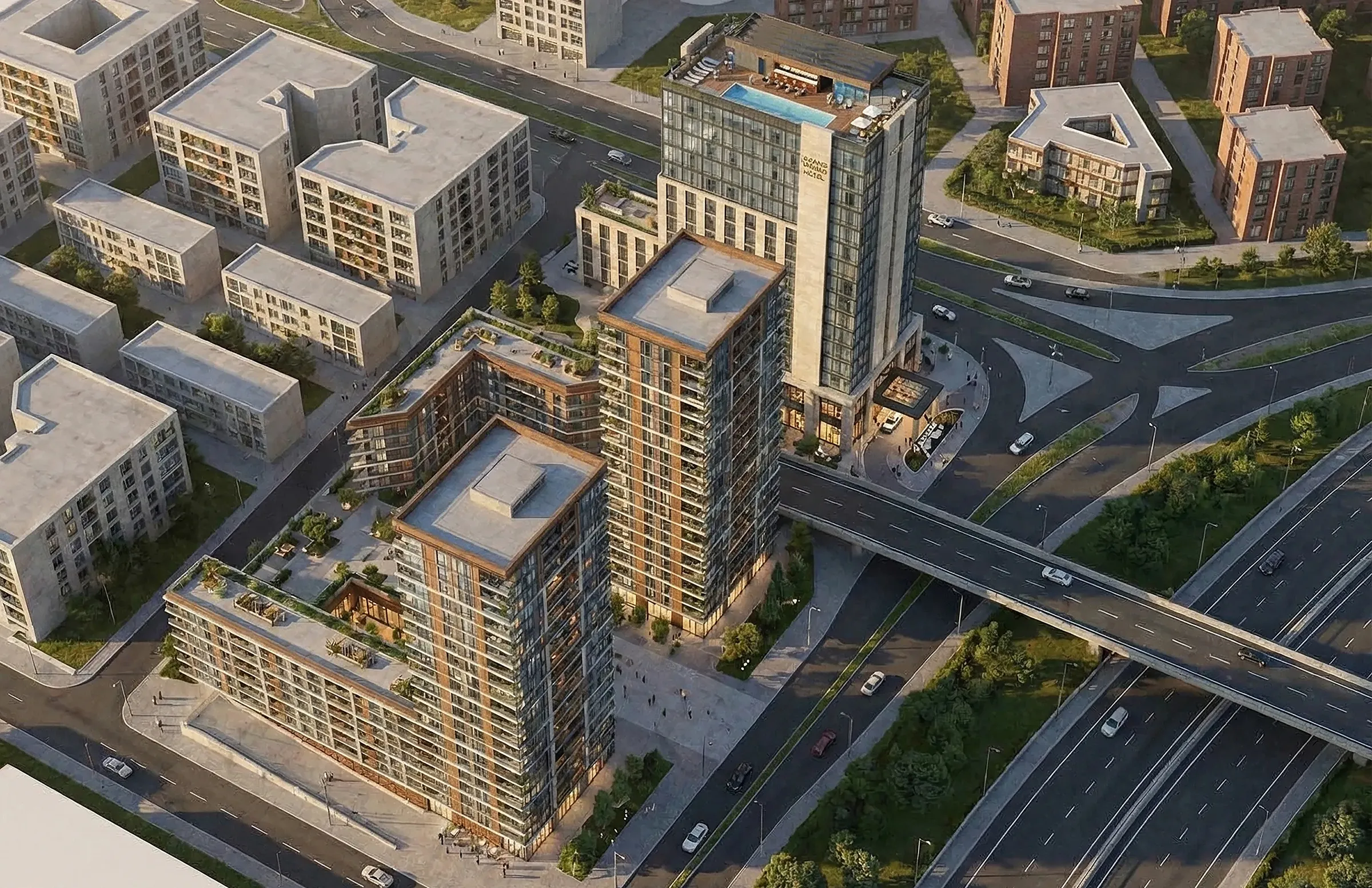
The project site is located in New Belgrade, within Block 12. Today, this area represents one of the most prominent and functionally significant parts of the city. The modern urban structure of open blocks, continuously developed from the 1940s to the present, largely constitutes a monumental urban fabric that reflects the economic, administrative, and cultural development of Belgrade. The primary objective is to preserve the established concept of construction, with the aim of maintaining and enhancing the achieved quality, given that this part of the city was developed according to the rules and principles of modern urbanism of the 20th century. The surrounding area is predominantly residential, mixed-use residential-commercial, and business-oriented, with a full range of commercial activities that, in addition to office and retail centers, include headquarters of major business corporations, hotels, and supporting entertainment and leisure facilities. To the north and east of the project site are the “Park of Friendship” and the “Palace of Serbia” complex. The project area is separated from adjacent blocks by a clearly defined orthogonal block matrix formed by Bulevar Nikole Tesle, Tresnjinog Cveta Street, and access roads leading to the developed part of Block 12. The largest remaining section of Block 12 is occupied by the built structure of the JU Business Center mixed-use complex, with a height of up to ground floor plus eight stories (G+8), characterized by a distinctive architectural expression, developed in the late 20th and early 21st centuries.

.svg)







In accordance with the Detailed Regulation Plan for a Part of Block 12, Municipalities of New Belgrade and Zemun (“Official Gazette of the City of Belgrade” No. 98/2017), the area covered by the urban planning project is designated as a mixed-use urban center—Zone M-S (ratio of residential to commercial uses = 0–90% : 100% : 10%). Within Zone M-S, in addition to residential and commercial uses in the fields of retail, hospitality, administration, and entertainment, the plan also includes a combined childcare facility, a healthcare center, and a library. The maximum permitted building cornice height within Zone M-S is 32 meters, while along Bulevar Nikole Tesle, high-rise buildings of up to 150 meters in height are allowed, in accordance with the Analysis and Confirmation of Criteria Fulfillment for High-Rise Construction. The proposed concept envisions an open-block typology characterized by residential towers (2Bs + G + 26), with a cornice height of 95 meters, positioned along Bulevar Nikole Tesle, while the interior of the block is defined by terraced residential buildings (2Bs + lG + hG + 7 + R), with a cornice height of 32 meters. These structures have dominant orientations and views toward Park in Block 10, the Danube River, eastward toward the Palace of Serbia, and the city center. Each plot includes one residential tower, one terraced residential building, and an underground garage. The total number of residential units on plot GP2 is 302—150 in the terraced building and 152 in the tower. Ground and mezzanine levels accommodate retail spaces and social infrastructure facilities. The ground floors and first floors are intended for various service and retail uses, social-standard facilities, and office spaces. The section of the complex where the terraced buildings are located is elevated to match the level of the existing plateau of the JU Business Center. This newly formed plateau gently slopes downward toward Bulevar Nikole Tesle in the form of a wide pedestrian ramp situated between the two residential towers. The newly designed landscaped pedestrian plateau and gently inclined ramp form a unified public space shared by both plots, serving as an area for leisure and social interaction. This newly created open public space, with a higher degree of attractiveness and urban character, positively influences the daily experience of its users. Pedestrian access to the residential entrances of the terraced buildings is provided from the elevated ground floor, i.e., from the newly formed plateau that aligns with the level of the existing JU Business Center plateau. Pedestrian access to the residential towers is provided from the ground level, corresponding to the existing site elevation. The remaining areas on the lower and upper ground floors are primarily intended for service-oriented functions, social-standard amenities, or retail spaces.
Given that one of the key goals of the Plan is the transformation of the existing industrial zone, the Greenery Analysis was introduced as an essential tool for ensuring environmental protection and enhancement of ecological values. The main sources of environmental pollution in the area were identified as high-intensity traffic roads, primarily Bulevar Peka Dapcevica, as well as existing industrial zones. Additionally, the area along the Kumodraz Stream was identified as being susceptible to erosion. The analysis included mapping and categorization of existing vegetation, recording both individual and grouped specimens according to their type and ecological quality. Existing low and medium vegetation, as well as tree lines, were identified as elements contributing to the landscape character of the site. The results of the vegetation valorization served as the basis for defining a network of existing and planned green areas, categorized as: Public green areas, and Green areas within other land-use zones (residential, commercial, and industrial). The planned green areas have a multifunctional role—to mitigate the negative impacts of traffic and industrial activities, and to improve the microclimate and overall living quality. Tree-lined streets are planned along all new roads to absorb noise and air pollution, while park-like squares are proposed at locations where valuable groups of existing high vegetation have been identified. Special emphasis is placed on the Kumodraz Stream corridor, where the formation of a protective green belt using native plant species is planned to reduce erosion risk. Within commercial, industrial, and mixed-use zones, mandatory landscaping of free surfaces is prescribed, including the use of semi-permeable pavement materials on open parking lots, enabling natural water infiltration and reducing surface runoff and pollution.