Plan guide. It shows the steps and all important information related to the plan development process, from the initial initiative to its adoption.
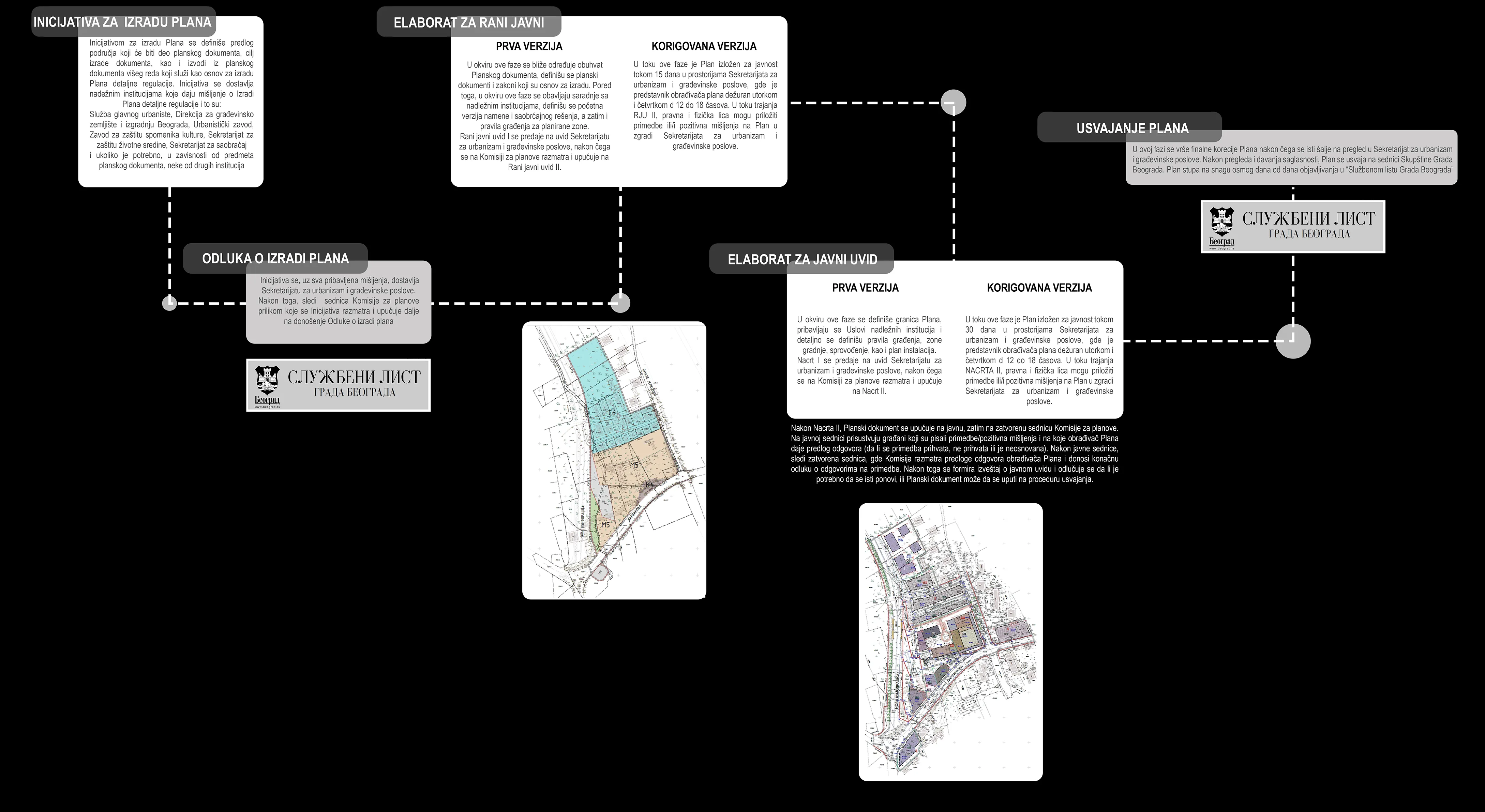
An objection/positive opinion may be written and submitted by any natural or legal person possessing an ID card. It is not necessary to be a professional in the field of architecture or urban planning in order to prepare and submit an objection/positive opinion.The objection should be clear and must refer specifically to the given Plan.
My name is ______, I am the owner of parcel ______, which is within the scope of the given Plan. Explanation of the issue on the parcel (specific land use, construction rules, building zone area, etc.). My suggestion is to consider _____, or to amend ______.
In addition to objections, it is also possible to submit a positive opinion on the Plan.
My name is ______, I am a resident of the settlement ______, and with this letter I submit a positive opinion on the planning solution which foresees (one of the missing uses – green areas, housing, roads, traffic areas, educational or cultural institutions, etc.), which will improve the quality of life in the settlement and/or solve a long-standing problem faced by the residents of this area.
By submitting objections to the draft of the planning document, you can influence its modification, while by writing a positive opinion, you can express satisfaction with the planning solution or a specific segment of it, which if supported by a greater number of positive opinions will have a higher chance of remaining unchanged in the subsequent planning phases.
On the Directorate’s website, on the page of the GIS application, enter your address or street in the upper left corner. On the left-hand side, open the tab CONTENT OF PLANS and enable the layers PLAN COVERAGE (for plans already in force) or PLANS IN PREPARATION (for plans currently being developed). Colored areas representing the coverage of different Plans will appear on the map, and by clicking on them, you will receive information about the Plan’s name, its current phase, and graphical attachments if the Plan has been adopted.
In the given area, there is no valid planning document that prescribes the rules for its treatment in terms of construction regulations (building height uniformity, formation of street frontage, distance of buildings from the regulatory line or roadway) and infrastructure (traffic access, required installations). In another case, there is an existing planning document that is outdated and requires revision.
The new planning document regulates such an area, introduces new functions, or enables the transformation of the block.
There is often confusion between a planning document and legalization, with these two terms being mistakenly interchanged. The purpose and objectives of preparing a planning document, as well as each of its elements, are entirely opposite to the concept of legalization. The adoption of a plan establishes the basis for location requirements necessary for construction. Consequently, the plan predetermines the permitted parameters.The legalization of a building, on the other hand, is contrary to the plan, since a constructed building is legalized retrospectively—meaning it was built in violation of regulations and rules or deviates from the planning document (exceeding the maximum permitted height, occupancy, etc.).