

Before
After
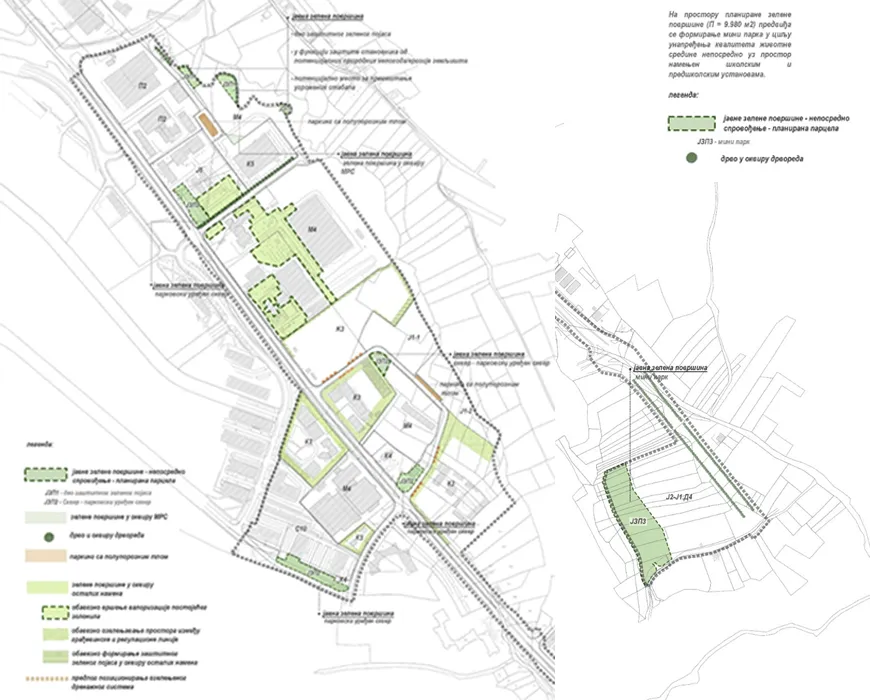
The Plan defines existing and newly planned land uses—industrial zones, residential areas, mixed-use urban centers, and areas intended for public services, primary schools, and kindergartens. In order to assess the potential impacts of the nearby industrial-commercial zone and high-traffic roads on the existing and planned uses—and to identify appropriate responses—an additional Greenery Analysis was introduced. The analysis begins with the mapping of pollution sources, which in this case include the industrial-commercial zones, the heavily trafficked Bulevar Peka Dapcevica, and several planned minor roads. The dominant types of pollution in the area are air pollution and noise. In addition, the retention area of the Kumodraz stream is identified as a zone with a potential risk of soil erosion due to the sloping terrain.These identified challenges served as a starting point for introducing elements aimed at mitigating their negative effects on the environment. The subsequent steps involved the analysis, mapping, and categorization of existing greenery. Field observations recorded low and medium vegetation, as well as existing mature trees. In defining the construction zones, the preservation of existing vegetation was given high priority in order to minimize the loss of trees. Finally, these construction zones were overlaid with the diagram of existing greenery, allowing for a more precise identification of trees located within each area. The diagram of planned greenery distinguishes two primary groups: Public green areas, and Green areas within other land uses. Following this main division, the designated green units were classified into different categories, depending on their intended treatment and the guidelines for their preservation and enhancement.

.svg)






The analysis of green areas and green elements serves as a tool for examining the existing conditions, collecting data necessary for conceptualizing future development, and guiding the process of spatial planning and land use. In addition to that, this analysis demonstrates the possibility of implementing such an approach within Detailed Regulation Plans, through the enhancement of currently prescribed legal requirements concerning the share of green surfaces.Urban environments—often associated with overbuilding, social alienation, and an inhumane lifestyle—should in fact represent spaces that accompany social development across various spheres, without compromising the fundamental conditions for a healthy life. Accordingly, urban development must be supported by amendments to the legal framework that take into account, among other things, social, cultural, and above all, climatic changes. Urban planners bear great responsibility in this regard, as they can, through the use of analyses and studies, more clearly define and shape planned urban units, respecting the existing context and providing guidelines for future growth.