

Before
After
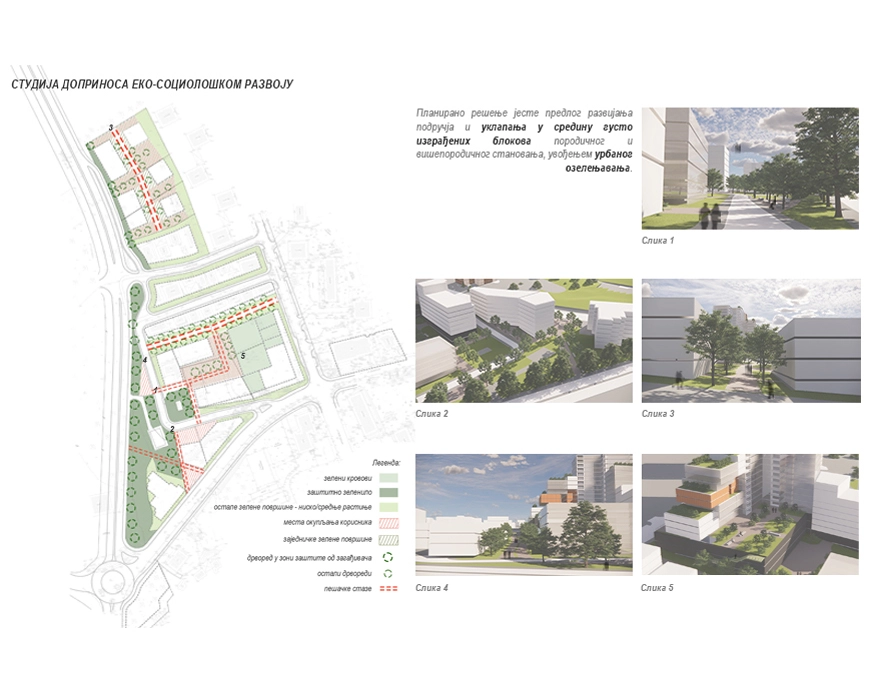
For the plan in question, an additional greenery analysis was introduced—the Study of Contribution to Eco-Sociological Development—as another form of verification and confirmation of the proposed solution. Since a high-rise building is planned within the project area, this study served as an instrument for exploring possible ways of improving and refining the chosen design, as well as for identifying and introducing potential constraints. The first step of the analysis involved creating a diagram of pollution sources at the site, mapping all existing and potential pollutants that could affect the quality of life of future residents. Key points requiring further attention were identified to ensure that the planned green elements would adapt to the current conditions and be utilized to mitigate or completely neutralize negative effects. Existing vegetation was also recorded and categorized. Based on the conditions provided by public utility companies and the mapped state of the site, zones were identified where additional evaluation of existing greenery was proposed, as groups of naturally grown vegetation of several decades in age were observed—these could, with proper treatment and supplementary planting, form the basis for establishing a new green fund. The mapped existing greenery was mostly located within shared-use areas, representing a potential for further interconnection and the creation of a new unit linked with the planned greenery in the project area. An integral part of the Study of Contribution to Eco-Sociological Development is a more detailed comparative analysis of two alternative approaches—spontaneous (unplanned) development and spatial integration. For both variants, a tabular overview of the green elements that could be introduced throughout the plan area was provided, along with their intended contribution—whether addressing climate change, local pollution, or improving users’ everyday quality of life—clearly indicating the differences between the proposed solutions.

.svg)






The analysis of green areas and general green elements serves as an instrument for reviewing the current condition, collecting information necessary for shaping further development, and guiding the ongoing process of design and spatial use. In addition, this analysis demonstrates the potential for its implementation within detailed regulation plans, through the enhancement of the legally prescribed percentages of green area inclusion. The urban environment—often associated with excessive construction, alienation of residents, and inhumane living conditions—should in fact represent a space that follows social development across various spheres without compromising the fundamental conditions for a healthy life. Accordingly, it is essential that urban growth be accompanied by amendments to legal frameworks that take into account, among other factors, social, cultural, and especially climatic changes. A great responsibility rests with urban planners, as through the preparation of plans and the use of various analyses and studies, they can more clearly define and shape planned units, respecting the existing context while providing guidelines for future development.