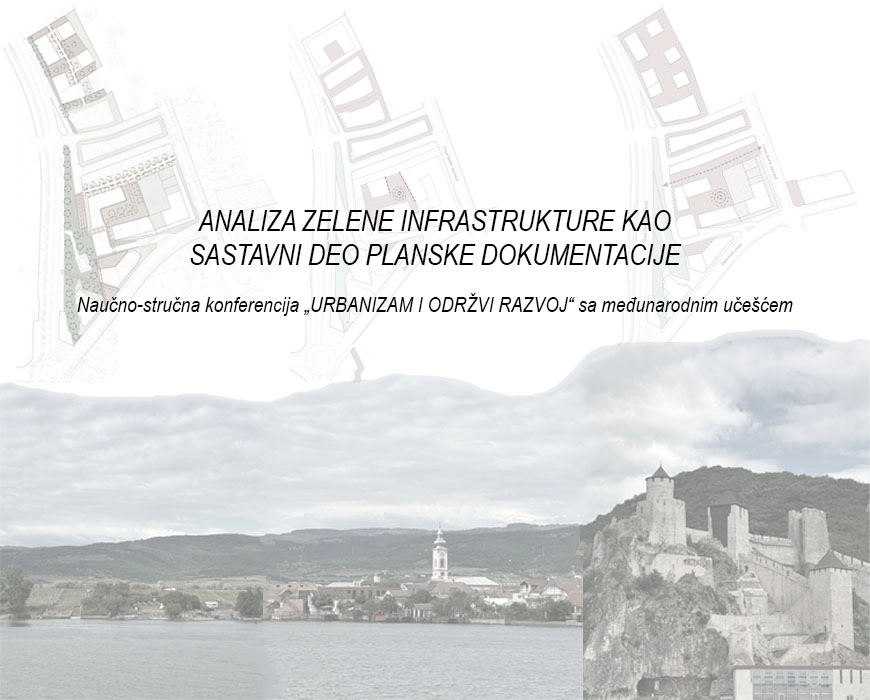
Scientific and Professional Conference “Urbanism and Sustainable Development” with International Participation
The conference topics included:
– conception, planning, design, and maintenance of housing (social, affordable, and non-profit housing);
– amendments to the legal framework for better regulation of green infrastructure, the green city, and public health;
– cadastral parcels from the urban planning perspective—plots with multiple purposes and contents;
– the use of 3D approaches in urban planning;
– post-adoption planning (implementation, enforcement, supervision, monitoring);
– urban planning and design for specific social groups (children, youth, elderly people, and persons with special physical and mental needs);
– sustainable development and the design of public spaces (examples from European Capitals of Culture).
Within the mentioned category, Miletic’s paper examines the challenges of contemporary urban environments, the way they change, and their influence on city residents and quality of life. The research explores how cities could adapt to the needs of their inhabitants in the future. In order to improve the relationship toward greenery and enhance the overall quality of life, the paper proposes a set of amendments to the legal framework that take into account social, cultural, and above all, climatic changes.
The paper presents analyses of green infrastructure as a tool for observing and evaluating green areas—both at the micro and macro level—and explores the possibilities of implementing these analyses within detailed regulation plans, through supplements to the existing legally prescribed percentages of green area participation. Two detailed regulation plans were analyzed, focusing on their development process supported by additional studies of green infrastructure and assessments of environmental and social impact. By integrating these analyses into the official planning documentation, their implementation becomes unambiguous and more effective.
The introduction of a Study of Contribution to Eco-Sociological Development as an integral part of detailed regulation plans allows further examination of potential development approaches in relation to the specific location and introduces the possibility of additional spatial constraints. The study analyzes the context and current characteristics of the area in order to establish the basis for higher-quality planning solutions. The final proposal represents a response to the conditions of the contemporary era—addressing social and climatic changes, the presence of greenery, pollution levels, typology of the surroundings, forms of newly planned structures, and types of open green spaces.
Last year, at the 20th Scientific and Professional Conference with International Participation – Urbanism and Sustainable Development, Teodora Miletic (M.Arch.) presented the paper “Ecological Index in Urban Planning – A Response to Overdevelopment and Climate Change,” which proposed the implementation of a greenery study as an integral part of planning documentation. The research presented this year builds upon that foundation, developing a methodological basis for the inclusion of greenery studies and analyses in the process of preparing detailed regulation plans. The results of this ongoing research were presented at the 21st conference in the paper “Analysis of Green Infrastructure as an Integral Part of Planning Documentation.”
ANALYSIS OF GREEN INFRASTRUCTURE AS AN INTEGRAL PART OF PLANNING DOCUMENTATION